









Running complex sourcing events without a clear playbook usually means dealing with missed deadlines, scattered vendor emails, and subjective proposal scoring. Establishing a clean RFP Distribution and Review process brings much-needed order to how you reach out to suppliers and weigh their proposals. By standardizing your RFP distribution workflow and applying proven RFP review best practices, your team keeps supplier communication organized from day one.
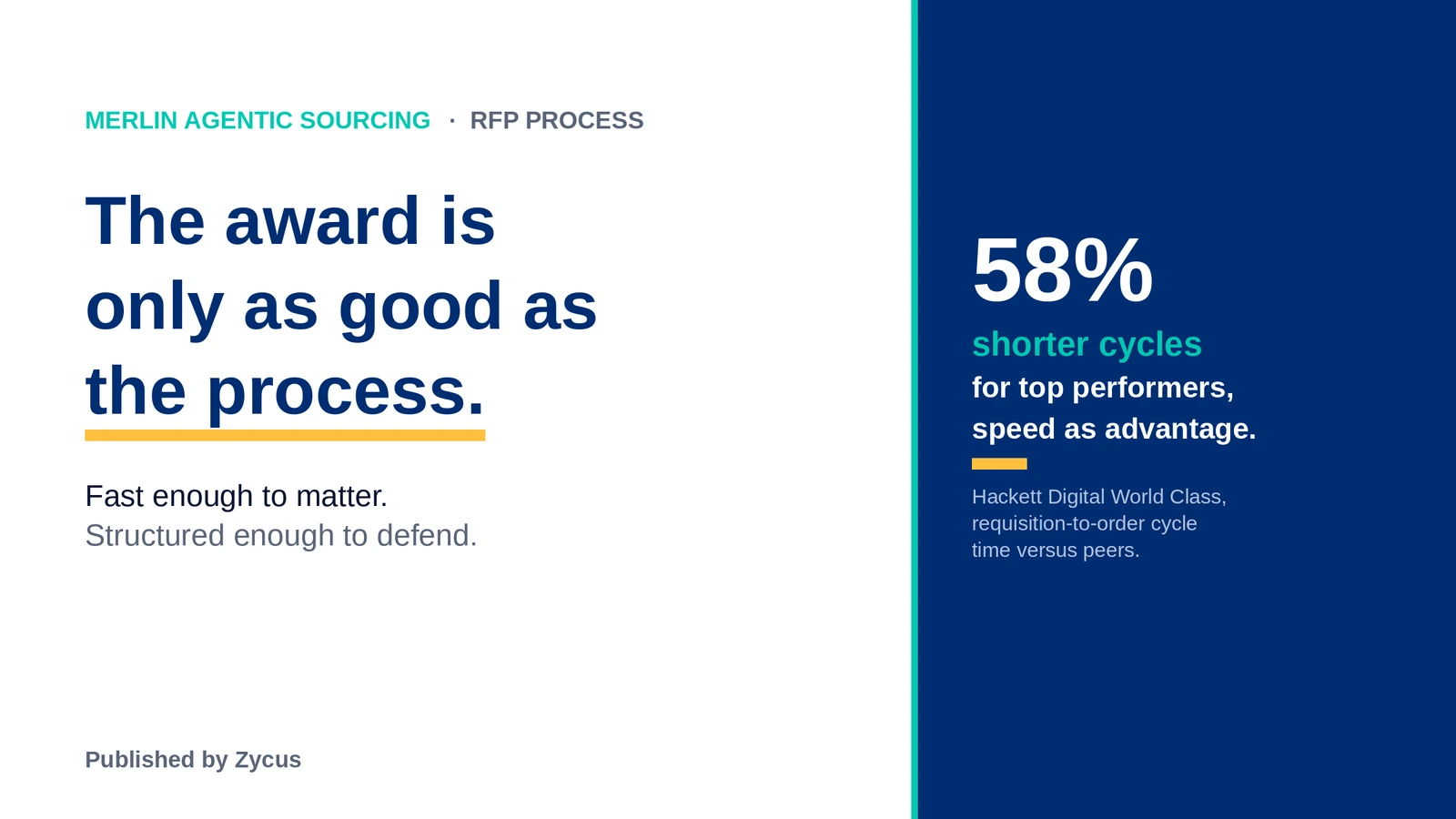
When supported by automated RFP scoring software, you can streamline the entire vendor proposal evaluation process, eliminate spreadsheet drag, and make confident, data-backed supplier choices. The award is only as good as the process that produced it. A well-structured distribution and review process is what turns a pile of responses into a decision you can defend.
TL;DR
- A structured distribution and review process is what makes an award fast, fair, and defensible.
- Speed is a real lever: top performers run requisition-to-order cycles 58% shorter than their peers.
- The pressure is rising: most procurement teams face flat budgets while their savings targets keep climbing.
- Structure the process around three things: who receives the RFP, how responses are normalized, and how the award is decided.
- Merlin Agentic Sourcing runs distribution, response normalization, and award modeling in one flow, so the process is consistent by construction.
A good award is the output of a good process, not a lucky read of the responses. The distribution and review stage, how the RFP goes out, how responses come back, and how the decision gets made, is where sourcing quality is won or lost. This guide is for VP of Sourcing and Director of Procurement leaders at health systems who want a distribution and review process that is fast enough to keep up and structured enough to defend.
Why does the distribution and review process decide the award?
Because by the time responses are in, most of the outcome is already determined by how the process was set up. If the RFP went only to the incumbent and one token alternative, the award was constrained before a single response arrived. If responses come back in incompatible formats, the review becomes an exercise in guesswork rather than comparison. If the scoring is decided after the responses are seen, it can be bent, consciously or not, toward a preferred answer.
Structure fixes all three. It sets who competes, how their responses are made comparable, and how the decision is scored, before the responses arrive to bias any of it. The process is not administrative overhead around the decision. It is the decision, made in advance and applied consistently. Everything after the responses arrive is, in a sense, just executing a decision the process already made, which is why time spent structuring the front of the process pays back many times over at the back of it.
Read More About Why Faster RFP Timelines Are a Revenue Story, Not an Efficiency One
How wide should distribution be, and to whom?
Wide enough to create real competition, targeted enough that every recipient is a credible supplier. The failure at one extreme is the courtesy RFP, sent to a field that was never going to win, which produces the appearance of competition without the substance. The failure at the other extreme is a blast to every possible vendor, which drowns the review in unqualified responses and signals to serious suppliers that the process is not serious.
The right distribution starts from a qualified field: suppliers that clear the approved-vendor and risk criteria, sized to the category. In a health system, that qualification step is also a compliance step, since an unvetted supplier should never have been in the field to begin with. Qualification is therefore not a gate that slows the process; it is what makes the competition real, since a field of credible suppliers is the only field that produces a genuinely contested award.
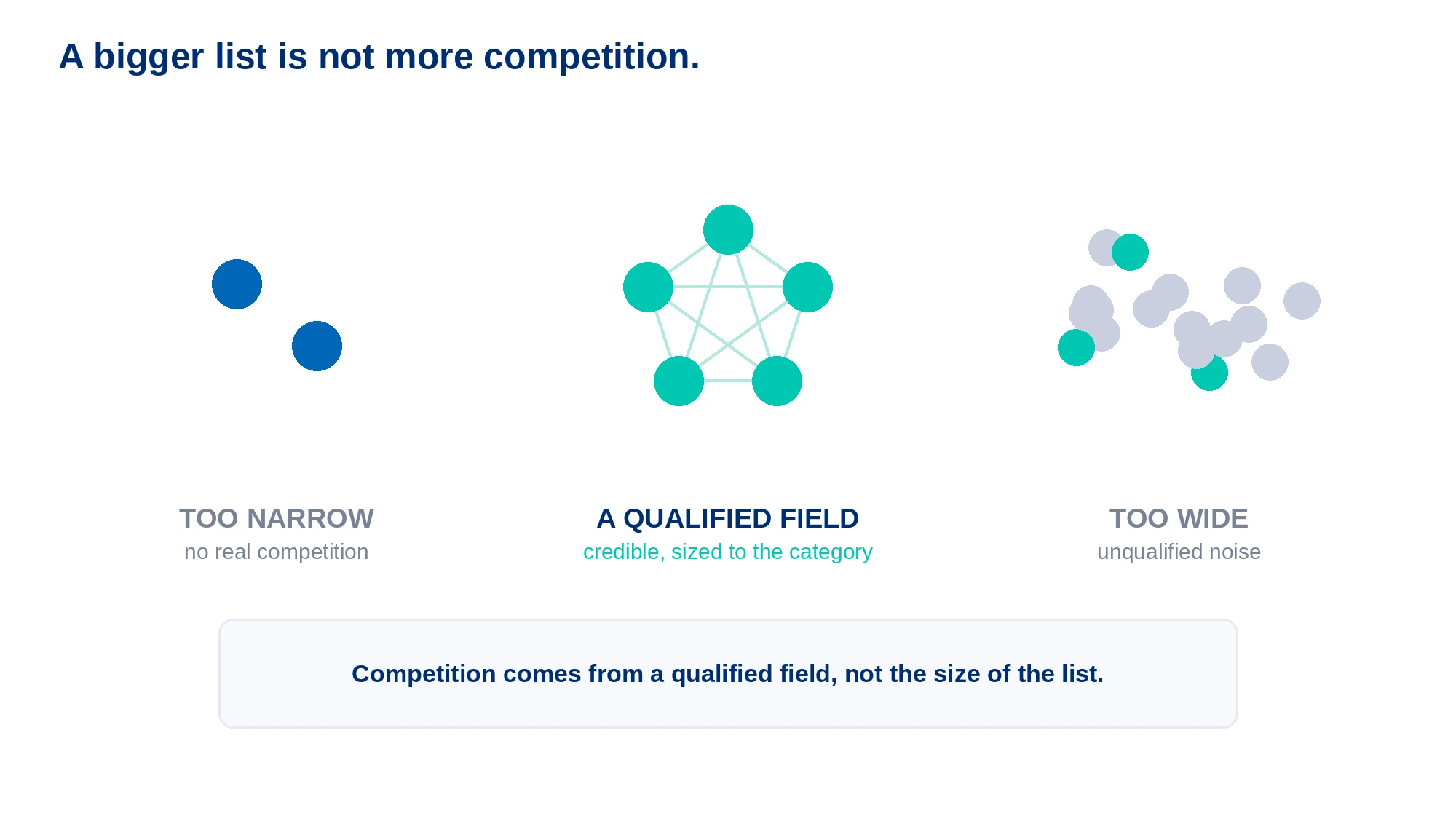
Figure 1. Right-size the field. Too few suppliers means no real competition; too many drowns the review in unqualified responses. A qualified field, credible and sized to the category, is where a contested, defensible award comes from.
Read More How To Calculate ROI on AI-Powered Sourcing in Healthcare Procurement in 2026?
Why is speed part of the structure, not the opposite of it?
Because a slow process is not a careful one, it is an exposed one. The longer an RFP sits in distribution and review, the more the value behind the award is deferred and the more the market can move underneath it. The Hackett Group finds that top-performing procurement organizations run requisition-to-order cycles 58% shorter than their peers and complete their sourcing cycles 24% faster, using speed as a deliberate advantage rather than a corner cut.
Speed done through structure, parallel steps, normalized responses, pre-agreed scoring, is what lets a team be both fast and rigorous. Speed done by skipping steps is just risk. The goal is a process fast enough that the award lands while it still matters, and structured enough that the speed never comes at the cost of defensibility. A team that treats speed and rigor as opposites will always sacrifice one, whereas a team that builds speed through structure gets to keep both, which is the entire point of designing the process deliberately.
How do you make responses actually comparable?
By normalizing them before anyone scores them. Suppliers will answer in their own formats, bundle line items differently, and describe the same capability in different language, and a reviewer comparing raw responses is comparing presentation as much as substance. Normalization means forcing responses into a common structure: the same pricing breakdown, the same line items, the same answer fields, so that like is compared with like.
This is where an inconsistent process quietly produces bad awards, because the supplier who formatted their response most persuasively scores higher than the supplier who offered the better deal. Structure removes that distortion by making the shape of every response the same before the content is judged. This is the least visible and most consequential step in the whole review, because its absence does its damage quietly, one plausibly-formatted response at a time.
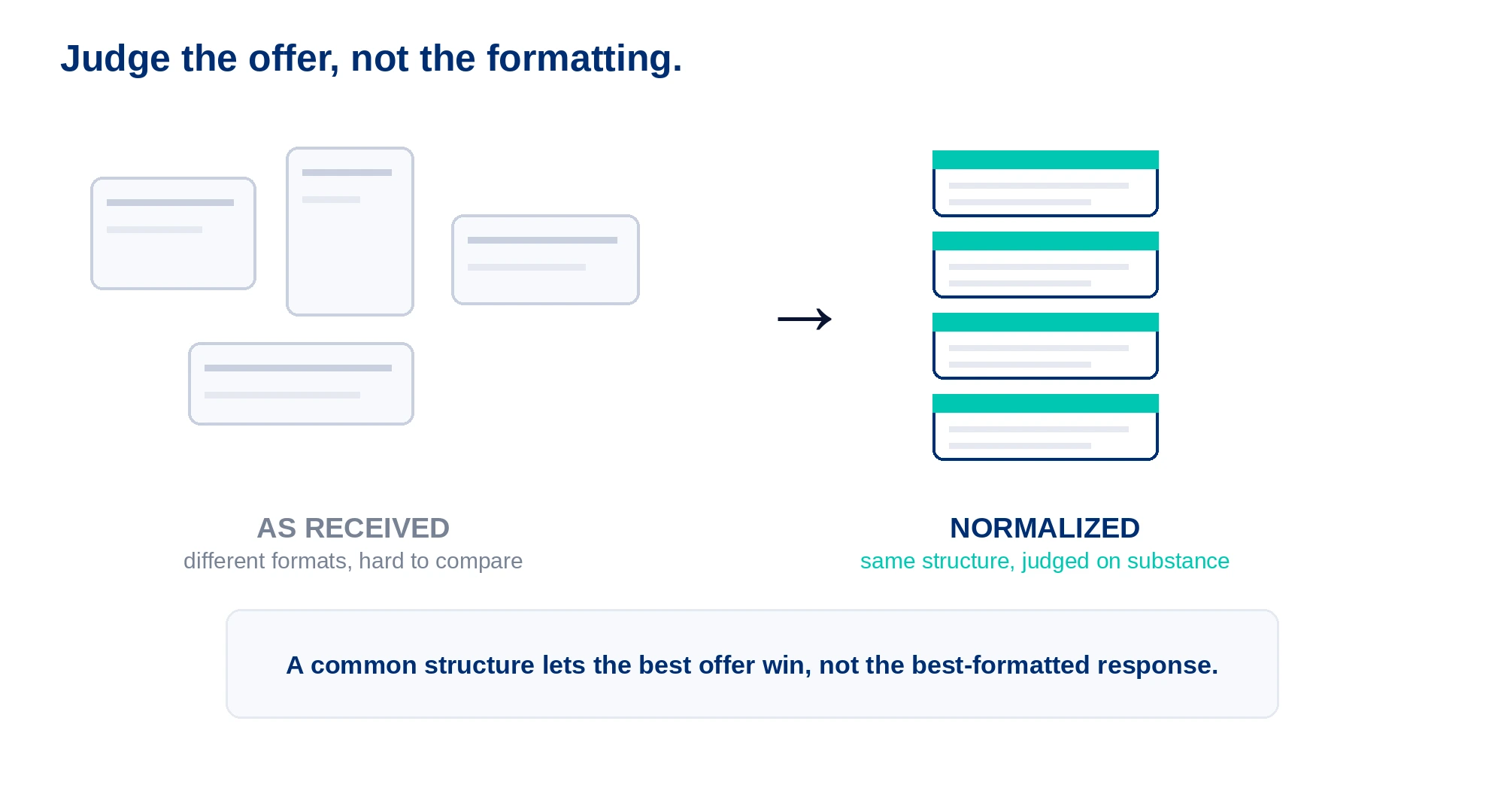
Figure 2. Normalize before you score. Responses arrive in different formats, so comparing them raw compares presentation as much as substance. A common structure lets like be judged against like.
How does agentic sourcing structure the process by construction?
By running distribution, normalization, and award modeling as one connected flow rather than three disconnected handoffs. Merlin Agentic Sourcing qualifies the supplier field against approved-vendor and risk criteria, manages the distribution and supplier communication, normalizes responses into a common structure automatically, and models award scenarios across the responses so the decision is scored on comparable terms.
Because the whole sequence runs on one data layer, the qualification done at distribution still holds at award, and the scoring applied is the scoring that was set. As a pre-launch product its cycle and response figures are design-intent, so treat them as the mechanism rather than a promised result. The structural point is that consistency is built into the flow, rather than depending on a reviewer to enforce it by hand under time pressure.
Check out Standardized RFP Templates for Behavioral Health Procurement: A Practical Guide
How do you keep the review fair when the pressure is on?
By fixing the scoring before the responses arrive and holding to it. The moment that most often breaks a review is the one where a deadline looms, a preferred supplier is close, and the scoring quietly flexes to close the gap. The defense is to agree the evaluation criteria and their weights up front, record them, and apply them as set. This matters more, not less, under pressure, because McKinsey finds that 55% of procurement leaders report flat or shrinking budgets even as 100% see their savings targets increase, which is exactly the condition under which shortcuts get rationalized.
A pre-agreed, recorded scoring model is what lets a team move fast without the speed becoming an excuse to bend the decision. The recorded scoring model is also what protects the buyer, since a decision made against criteria set in advance is a decision no one can later accuse of having been reverse-engineered.
What does a defensible award trail look like?
It shows the field that was invited and why each supplier qualified, the responses as normalized, the scoring criteria as agreed in advance, and the decision as scored against them. Anyone reviewing it later, a CFO, an auditor, a regulator in a healthcare context, can reconstruct not just what was decided but why, without having to take the buyer’s word for it.
That trail is the real product of a structured process. The award is the headline, but the trail is what makes the award hold up when someone asks how it was reached. Structure is what produces the trail as a byproduct, rather than as a document someone has to assemble after the fact. A trail like that is not extra work produced after the fact; it is the natural residue of a process that was structured correctly in the first place.
Conclusion
A well-organized RFP Distribution and Review process is what turns a noisy sourcing event into a predictable, high-value contract. Following clear RFP review best practices throughout your RFP distribution workflow keeps team evaluations objective, fast, and fully audit-ready. By replacing manual spreadsheet reviews across your vendor proposal evaluation process with automated RFP scoring software, procurement teams cut cycle times significantly and focus on strategic negotiation.
Want a sourcing process that is consistent by construction? Merlin Agentic Sourcing runs distribution, response normalization, and award modeling in one governed flow, so every award comes with the trail that makes it defensible. It is part of the Merlin Agentic Platform, Zycus’s Intake-to-Outcomes architecture for governed, multi-agent procurement. Request a demo to see the process end to end.
Frequently Asked Questions
Q1. How should you structure the RFP distribution and review process?
Around three decisions made in advance: who receives the RFP (a qualified, compliant field sized to the category), how responses are normalized into a common structure so like is compared with like, and how the award is scored (criteria and weights agreed before responses arrive). Structure applied up front is what makes the award both fast and defensible.
Q2. How many suppliers should an RFP go to?
Enough to create real competition, few enough that every recipient is credible. Avoid the courtesy RFP sent to a field that cannot win, and avoid the blast to every vendor that drowns the review in unqualified responses. Start from a qualified field that clears approved-vendor and risk criteria, which in healthcare is also a compliance step.
Q3. Why does speed matter in the RFP review process?
Because a slow process defers the value behind the award and lets the market move underneath it. Hackett finds top performers run requisition-to-order cycles 58% shorter than peers by using structure, parallel steps, normalized responses, and pre-agreed scoring, rather than by skipping steps. Speed through structure is rigorous; speed by cutting corners is risk.
Q4. How do you make supplier responses comparable?
Normalize them before scoring. Force responses into a common structure with the same pricing breakdown, line items, and answer fields, so reviewers compare substance rather than presentation. Without normalization, the best-formatted response can outscore the best actual offer.
Q5. How do you keep an RFP evaluation fair under deadline pressure?
Fix the scoring criteria and weights before responses arrive, record them, and apply them as set. Pressure, especially the flat-budget, rising-target pressure most teams face, is exactly when scoring tends to flex toward a preferred answer, so a pre-agreed, recorded model is the safeguard.
Q6.How does Merlin Agentic Sourcing structure the RFP process?
It runs supplier qualification, distribution, response normalization, and award modeling as one connected flow on a single data layer, so qualification done at distribution still holds at award and the scoring applied is the scoring that was set. As a pre-launch product, its cycle and response figures are design-intent.
Q7. What is response normalization in sourcing?
It is the step of forcing supplier responses into a common structure before evaluation, so pricing, line items, and answers line up and can be compared directly. It removes the distortion where a persuasively formatted response outscores a genuinely better offer.